Network Foundation
Private Network
Control
Manage traffic within isolated networks.
Private
NETWORKS
Custom
ROUTING
Isolated
RESOURCES
Host360 Virtual Private Cloud (VPC) enables organizations to deploy cloud resources within logically isolated network environments. Define network boundaries, control traffic flows, and securely connect applications, services, and infrastructure.
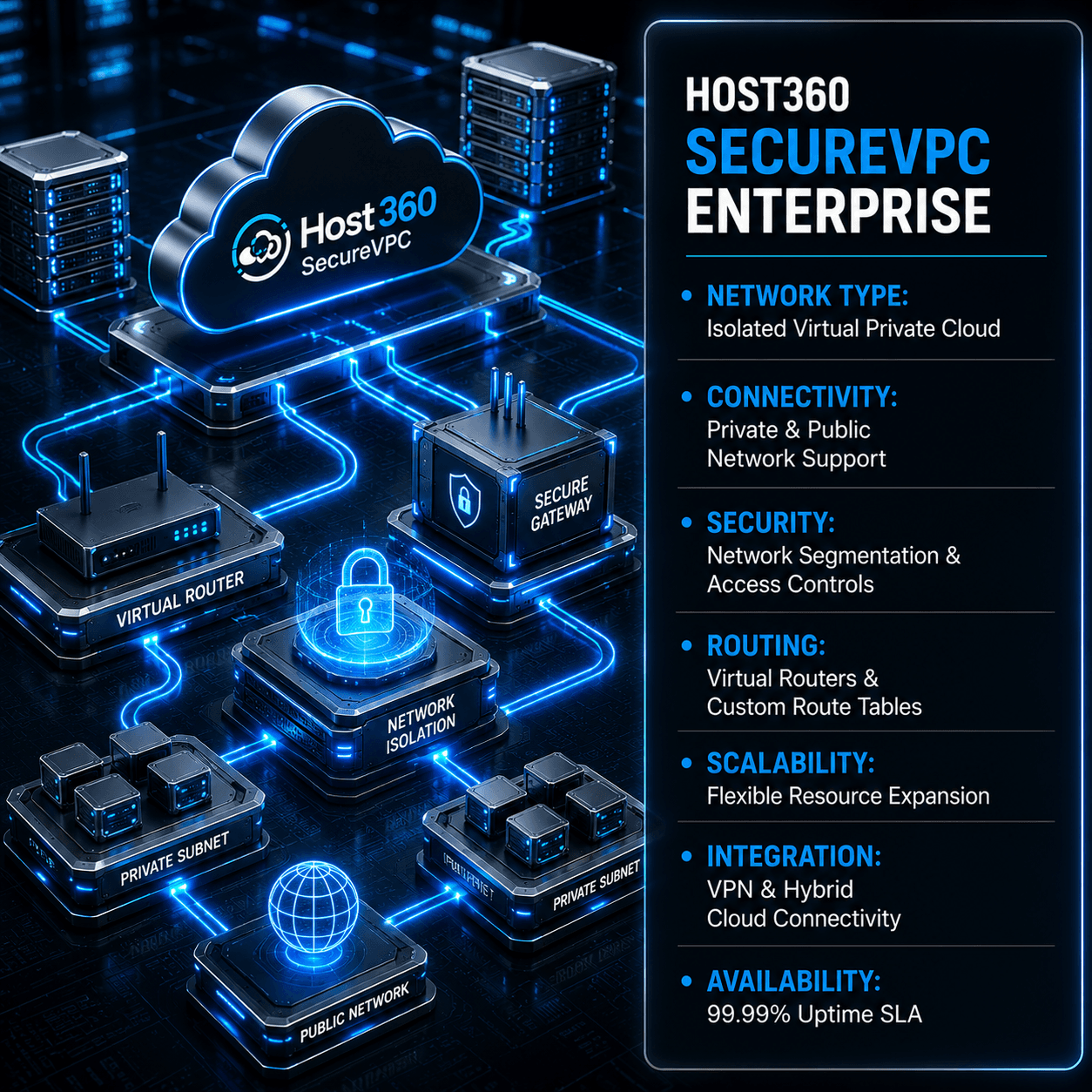
NETWORK SPECIFICATIONS
Host360 Virtual Private Cloud (VPC) provides isolated networking environments for cloud resources. Configure network segmentation, routing policies, IP allocation, and connectivity controls to support enterprise workloads.
Design isolated network environments for applications, services, databases, and enterprise cloud infrastructure.
Provide dedicated networking for application environments.
Separate data resources from public-facing systems.
Enable isolated environments for development activities.
Extend network connectivity across environments.
Separate data resources from public-facing systems.
Network Capabilities
Create dedicated cloud network environments.
Manage traffic within isolated networks.
NETWORK DEPLOYMENT
Create isolated network environments for cloud resources through a structured deployment process.
Select a network architecture based on workload isolation, connectivity requirements, and operational scope.
| Feature | Workload Isolation Application VPC Dedicated networking for cloud applications. Contact Sales Application Networks | Centralized Resources |
|---|
NETWORK RESOURCES
Discover networking services and architectures that complement Virtual Private Cloud deployments.
FREQUENTLY ASKED QUESTIONS
Learn about virtual private cloud networking, resource isolation, connectivity, and cloud network design.
A VPC is a logically isolated network environment within a cloud platform that allows organizations to deploy and manage cloud resources within dedicated network boundaries.
Organizations use VPCs to separate workloads, organize cloud resources, control network communication, and establish dedicated networking environments.
Virtual machines, databases, applications, containers, storage services, and other cloud resources can be deployed within a VPC.
Yes. A VPC can be divided into multiple subnets to organize workloads, separate environments, and structure network traffic.
A VPC creates logical network boundaries that separate resources from other cloud environments while allowing controlled communication where required.
Yes. Organizations commonly deploy separate network environments for development, testing, staging, and production workloads.
Resources communicate through configured network routes, internal addressing, and defined connectivity policies within the virtual network.
Yes. A VPC can be configured to communicate with external services, remote locations, cloud resources, and organizational networks based on connectivity requirements.
We reply within 2 hrs · IST business hours
Build isolated network environments for applications, databases, and cloud infrastructure with flexible routing, segmentation, and connectivity controls.
Separate workloads by network.
Control traffic flow paths.
Organize resources by subnet.
Restrict network communication.
| Multi-Environment Enterprise VPC Support multiple teams and workloads. Custom Quote Organization Scale |
|---|
| Primary Purpose | Application Hosting | Shared Resources | Organization Networking |
| Typical Users | Product Teams | Platform Teams | Multiple Departments |
| Network Scope | Single Workload | Multiple Services | Multiple Environments |
| Resource Ownership |
SECURITY
Define network traffic policies.
| Platform Managed |
| Central IT |
| Deployment Focus | Application Delivery | Service Consolidation | Infrastructure Governance |
| Connectivity Pattern | Workload Specific | Shared Access | Cross-Environment |
| Expansion Model | Workload Growth | Service Expansion | Organizational Growth |