RTX PRO 6000 Prices Have Nearly Doubled: Should You Buy the Card or Rent It in 2026?
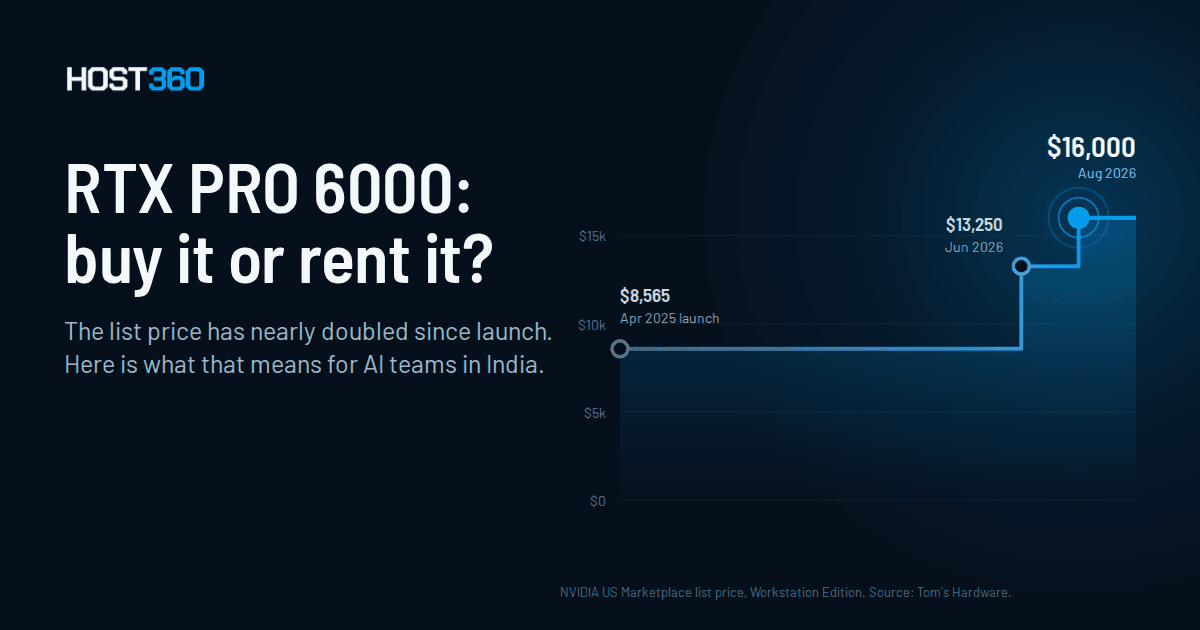
For most teams in India, renting an RTX PRO 6000 makes more financial sense than buying one in 2026. NVIDIA's own US store now lists the card at $16,000, up from $8,565 at launch in April 2025, and that is before server hardware, import costs, power and a wait that can run for months.
Buying still wins in one situation: you will keep the GPU busy close to 24 hours a day for two years or more, you already have rack space and power, and you can wait for delivery. If any of those three is missing, rent.
Key takeaways
- The RTX PRO 6000 Blackwell list price has risen about 87% since launch, from $8,565 to $16,000, with no change to the hardware.
- The main cause is the memory shortage. Each card carries 96 GB of GDDR7, which makes it unusually exposed to memory prices.
- Market reports put lead times for Blackwell PRO GPUs at three to seven months, and longer for multi-GPU servers.
- At around $2 per GPU-hour, the card's price alone equals roughly 8,000 hours of rental, about 11 months of round-the-clock use, before you count the server, power or cooling.
- The RTX PRO 6000 is a strong inference and fine-tuning GPU, but it has no NVLink. For large multi-GPU training, an H100, H200 or B200 is the better tool, whether you buy or rent.
How the RTX PRO 6000 price got to $16,000
The RTX PRO 6000 Blackwell doubled in price in about 17 months without a single hardware change. NVIDIA never announced the increases; the listing on its US Marketplace simply changed. Here is the sequence for the Workstation Edition, as tracked by Tom's Hardware:
- March 2025: pre-orders briefly as low as $7,673, after the card was announced at NVIDIA GTC.
- April 2025: the card goes on sale at $8,565 for a single unit and $8,435 for bulk orders.
- June 2026: NVIDIA's Marketplace price rises to $13,250.
- August 2026: it rises again, to $16,000, roughly 87% above the launch price.
Retailers do not move in step. In the same week NVIDIA listed $16,000, Tom's Hardware found the card at $13,998 on Newegg and $15,499 at B&H. That spread is a warning sign in itself: when the same SKU varies by $2,000 between sellers, a quote is only good for as long as current stock lasts.
For an Indian buyer, the US list price is only the starting point. Freight, customs duty, distributor margin and exchange rate all sit on top of it, and the card is useless on its own: it needs a server built to carry it.
Why the RTX PRO 6000 is so hard to buy right now
The short version is memory. The RTX PRO 6000 carries 96 GB of GDDR7, more than any other NVIDIA workstation card, and memory is the part of the supply chain that is under the most pressure in 2026.
AI data centres are buying memory at a scale the industry has not seen before. Memory makers are giving priority to the most profitable products, so GDDR7 is in short supply even though it is a different part from the HBM used in data centre GPUs like the H200 and B200. A card that needs 96 GB of it feels every step of that squeeze, which is why its price has moved more than most.
The second problem is time. Electronic components distributor Fusion Worldwide reported in March 2026 that Blackwell PRO GPUs were commonly sitting at lead times of three to seven months, with allocations shifting from week to week. Its advice to buyers was to treat three to six months or longer as normal rather than exceptional.
For a server deployment, the wait usually gets longer, not shorter. Data centre buyers need the Server Edition inside a validated chassis from an OEM, so the GPU lead time stacks on top of the server build, shipping and customs clearance.
That changes the maths in a way the sticker price does not show. A team that orders hardware today might start using it in the first quarter of 2027. If the project needs to start this month, the purchase price is not the real comparison; the cost of waiting is.
Workstation Edition or Server Edition: which one are you pricing?
Most price headlines, including the $16,000 figure, refer to the Workstation Edition. Cloud providers and data centres run the Server Edition. They share the same chip but are built for different places, and buyers regularly compare the wrong one.
NVIDIA sells the RTX PRO 6000 Blackwell in three versions:
- Workstation Edition: a desktop card with its own fans, 600 W of board power and 1,792 GB/s of memory bandwidth. Built for a single powerful workstation under a desk.
- Max-Q Workstation Edition: a 300 W version with a blower cooler, so several cards can sit side by side in a workstation without overheating.
- Server Edition: a passively cooled card for rack servers. It relies on the server's fans for airflow, draws up to 600 W (configurable), and runs at 1,597 GB/s.
All three share the parts that matter most for AI work: 24,064 CUDA cores, 752 fifth-generation Tensor Cores with FP4 support, 188 RT Cores and 96 GB of GDDR7 with ECC. The Server Edition can also be split into up to four isolated GPU instances of 24 GB each using Multi-Instance GPU (MIG), which lets several smaller workloads or teams share one card safely.
One limit applies to every version: there is no NVLink. Multi-GPU jobs talk over PCIe, which is fine for inference and fine-tuning on one or a few cards, and slow for large training runs that split a model across many GPUs.
So if you plan to run the card in a data centre, price a Server Edition inside a certified server, not a boxed Workstation card. A Workstation card in a rack is a cooling problem; a Server Edition under a desk will overheat without server airflow.
What it really costs to own an RTX PRO 6000 in India
The card is only the start. Before an RTX PRO 6000 does any useful work in India, you pay for:
- The GPU itself, at today's price, plus freight, customs duty and distributor margin, all exposed to the rupee-dollar rate on the day you pay.
- The server around it: CPUs, system memory, NVMe storage, high-speed networking and a chassis with enough airflow and power supplies for 600 W cards.
- A place to run it: rack space in a data centre or a server room with the power and cooling to handle several kilowatts per server.
- Electricity, every hour: the GPU, the rest of the server, and the cooling that removes the heat.
- People and spares: setup, drivers, monitoring, failed parts and the engineer who gets the call at 2 a.m.
- The wait: three to seven months in which you have paid, or committed to pay, and your project is not running.
The break-even maths
The question to answer is simple: how many hours of rental would the same money buy?
Break-even hours = total cost of owning the GPU ÷ hourly rental rate
Take only the card, at $16,000, and an on-demand rate of $2.00 per GPU-hour. That is 8,000 GPU-hours. Running non-stop, that is about 11 months. At 12 hours a day, it is about 22 months. At typical office-hours use of 6 hours a day, it is more than three and a half years.
That is the best case for buying, because it ignores everything except the card. Add the server, power and people, and the break-even point moves further out.
Power alone is a meaningful line. As an illustration, assume each GPU slot draws about 1 kW including its share of the server, a data centre overhead (PUE) of 1.5 and a commercial tariff of ₹9 per kWh. That comes to roughly ₹1.2 lakh per GPU per year in electricity, before any other cost. Use your own state tariff and server spec; the point is that it is a recurring cost the rental rate already includes.
There is also a time limit on the investment. NVIDIA has already announced its next data centre architecture, Rubin. A GPU bought in 2026 needs to earn back its cost before newer cards make its hourly value fall.
Buy, rent, or choose a different GPU
Buying makes sense when
- The GPUs will run close to 24 hours a day for at least two years, on a workload you can predict.
- You already have data centre space, power and an operations team, so the server is the only new cost.
- A policy requires the hardware to sit on your premises, and an India-hosted dedicated or private cloud server will not satisfy it.
- You can wait several months for delivery without delaying revenue.
Renting makes more sense when
- The project needs to start this month, not next quarter.
- Usage comes in bursts: a fine-tuning run, a proof of concept, a rendering deadline, a product launch.
- You are still choosing between models or GPUs and do not want to lock into one card for three years.
- You want to grow from one GPU to eight, and back, without buying for the peak.
- You would rather your engineers spent their time on the model than on drivers, cooling and failed parts.
There is a middle path that many teams miss. A monthly or annual commitment on cloud GPUs costs less per hour than on-demand, gives you dedicated capacity, and still avoids the purchase, the wait and the hardware risk. For steady workloads that do not justify a hardware purchase, it is usually the cheapest option.
When the RTX PRO 6000 is the wrong choice entirely
The RTX PRO 6000 is excellent for inference and fine-tuning. With 96 GB on one card, a 70-billion-parameter model quantised to FP8 can run on a single GPU, which keeps serving simple and cheap. In CloudRift's published benchmarks, it beat an H100 SXM on single-GPU LLM inference at about 28% lower cost per token. It is also a strong card for rendering, virtual workstations and video, with four NVENC encoders on board.
The same benchmarks show its limit. On 8-GPU tensor-parallel workloads, H100 and H200 systems with NVLink pulled three to four times ahead. If you are pre-training a model or running large distributed training across many GPUs, choose an H100, H200 or B200, whether you buy or rent. Paying less per hour for a GPU that takes three times as long is not a saving.
Renting an RTX PRO 6000 on Host360
Host360 has RTX PRO 6000 Blackwell Server Edition capacity available now, hosted in data centre location(s) in India. There is no procurement cycle and no three-to-seven-month wait: our team sizes the configuration with you and gets you running in 4-hours.
Pricing is set up for the way GPU projects actually run:
- On-demand for proofs of concept, benchmarks and short projects.
- Ask for credits on new accounts, so you can test your own model on the card before you commit.
- Billing in INR, with your data and workloads kept in India.
Host360 is the cloud business of Comprint, an Indian IT company founded in 1994, which has run GPU cloud infrastructure since 2020. Our solutions architects can also tell you honestly when an RTX PRO 6000 is not the right card for your job, and what is.
Frequently asked questions
1. What is the current price of the RTX PRO 6000 Blackwell?
NVIDIA's US Marketplace has listed the RTX PRO 6000 Blackwell Workstation Edition at $16,000 since August 2026, up from $8,565 at launch in April 2025. Retail prices vary by seller, and Indian buyers pay freight, customs and distributor margin on top.
2. Why has the RTX PRO 6000 price gone up so much?
NVIDIA has not explained the increases, but they track the 2026 memory shortage. Each card uses 96 GB of GDDR7, and memory makers are prioritising AI data centre products, which leaves high-memory workstation cards especially exposed.
3. How long does it take to get an RTX PRO 6000 in 2026?
Distributor Fusion Worldwide reported lead times of three to seven months for Blackwell PRO GPUs in March 2026. Complete multi-GPU servers usually take longer, because the server build and shipping add to the GPU wait.
4. What is the difference between the Workstation Edition and the Server Edition?
Both use the same chip with 24,064 CUDA cores and 96 GB of GDDR7. The Workstation Edition has its own fans for desktops. The Server Edition is passively cooled for rack servers, runs at 1,597 GB/s and supports up to four MIG instances of 24 GB each.
5. Is it cheaper to rent or buy an RTX PRO 6000?
For most teams, renting is cheaper. At $2 per GPU-hour, the $16,000 card price alone equals about 8,000 hours of rental, roughly 11 months of 24/7 use, before server, power and staff costs. Buying wins only with sustained, near-constant use over two years or more.
6. Can an RTX PRO 6000 run a 70B model?
Yes. With 96 GB of memory, a 70-billion-parameter model quantised to FP8 fits on a single card with room for the KV cache, which makes it a strong single-GPU option for serving mid-sized open models.
7. Does the RTX PRO 6000 support NVLink?
No. Multiple RTX PRO 6000 GPUs communicate over PCIe. That works well for inference and fine-tuning, but for large distributed training an H100, H200 or B200 with NVLink is the better choice.
Run the numbers on your own workload
Every buy-or-rent decision turns on three inputs: how many GPU-hours you will really use, how soon you need them, and how long the workload will last. Share those with our team and we will put an owned server and a rented configuration side by side for you, with your numbers rather than ours.
Sources
- Tom's Hardware: Nvidia doubles RTX PRO 6000 Blackwell's MSRP to $16,000 (12 August 2026)
- Tom's Hardware: Nvidia raises RTX PRO 6000 Blackwell pricing to $13,250 (June 2026)
- Electropages / Fusion Worldwide: GPU shortage and price increases in 2026 (26 March 2026)
- NVIDIA RTX PRO 6000 Blackwell Server Edition product page and datasheet
- CloudRift: RTX PRO 6000 vs H100, H200 and L40S LLM inference benchmarks
- ComputePrices.com: RTX PRO 6000 cloud pricing across providers
Prices and lead times in this article reflect public reporting up to Oct 6, 2026 and change frequently. The break-even and electricity figures are illustrations with stated assumptions, not quotes. Get dated quotes for both hardware and cloud capacity before deciding. Last updated Oct 6, 2026.